
Klein CuracaoEverything about the uninhabited island
Lighthouse, shipwrecks, sea turtles and the most beautiful beach of the ABC islands: discover everything about Klein Curacao.
What is Klein Curacao?
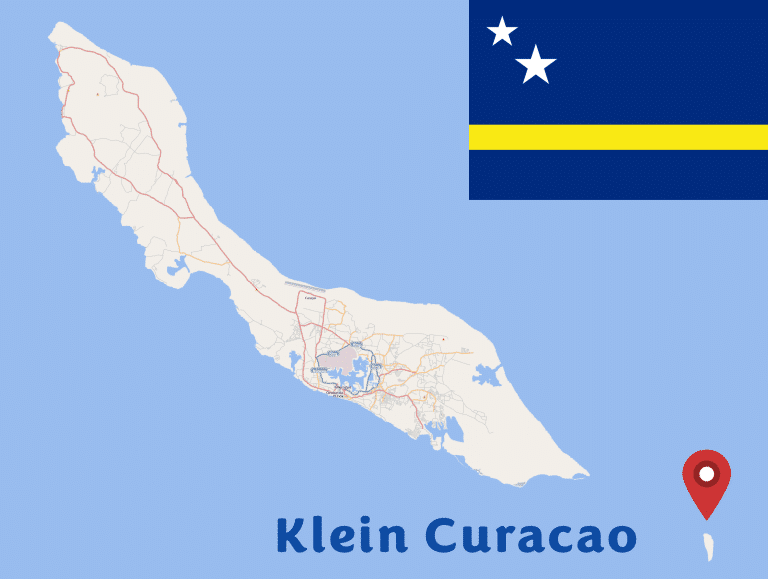
Klein Curacao is located 10km southeast of Curacao . It is an uninhabited, tropical, bounty island in the Caribbean Sea with a surface area of 1.7km2.
When you look at the flag of Curacao there are always two white stars on it, one large and one somewhat smaller. The big star represents Curacao and the smaller star represents Klein Curacao.
Features of Klein Curacao
The most striking features of Klein Curacao and what the tropical bounty island offers is the beautiful snow-white beach , an azure blue sea, a beautiful underwater world, a spectacular reef under the crystal clear water, of course a lot of peace and fabulous views.
And not to be missed, the two absolute eye-catchers of the island of course, a must see, the iconic lighthouse, the Prince Hendrick Tower (still working, but now solar-powered) and the beached large oil tanker, the Maria Bianca Guidesman, now the famous rusty shipwreck.

Finally, of course, Klein Curacao is known for the large sea turtles and dolphins that like to hang out around the little island.
Since 1990, the bounty island has only been used for organized day trips. From various locations such as Jan Thiel beach, Caracas Bay and Santa Barbara, you can join a Klein Curacao trip completely all inclusive.
Features of Klein Curacao
Apart from tourism, Klein Curacao also serves as a breeding ground for various animals such as the American Dwarf Tern, Hawksbill Turtle, Green Turtle and Striped Anolis.
However, Klein Curacao used to have an entirely different function. The small island was used by the West India Company to quarantine sick slaves. The deceased slaves were buried on the island.
Not long after, English mining engineer John Godden discovered phosphate on the islet which was mined in the following years.
The Prins Hendrik Lighthouse
One of the most striking and unique features of Klein Curacao is the old iconic pink lighthouse in the middle of the uninhabited island. There was first a lighthouse built on Klein Curacao in 1849 and this lighthouse was called the Prins Hendrik Lighthouse. Unfortunately, this lighthouse was destroyed during a hurricane in 1877. However, it was important for shipping that there would be a good lighthouse on Klein Curacao, so in 1877 they rebuilt the lighthouse right away. Then, in 1913, the lighthouse was rebuilt into the lighthouse that can still be seen today.
The historic lighthouse is 20 meters high and still has an active status. In fact, Klein Curacao is a rather flat island, making it easy for ships to overlook it. This is how the shipwrecks that remain on the island today ended up there. That is why it is important to have a lighthouse that works well. In 2018, they made another modification to the lighthouse. In fact, the lighthouse now has an LED system that runs on solar power! The lighthouse lamp flashes twice every 15 seconds and its range is 15 nautical miles. This is about 27,780 meters!
What makes the lighthouse so unique?
The reason this lighthouse is unique is first of all its distinctive appearance. Usually lighthouses are white or white with red stripes, for example. The lighthouse on Klein Curacao, however, has a pink appearance. Although the lighthouse itself has a sand color, the outbuildings around it are pink.

This makes the lighthouse look beautiful and unique. Be careful, however, when visiting the lighthouse on Klein Curacao. The floors on the second floor are not solid throughout. However, a complete renovation of the building began in 2017. During phase 1, the roof was renewed and new tiles were also installed. The goal is for the lighthouse to be restored to its full glory.
The shipwrecks
The bounty island has a turbulent past and one of the reasons for this is because Klein Curacao is located on a busy sailing route to and from the ABC islands. Because Klein Curacao is a rather flat bounty island, it is also very easy to miss. As a result, a number of ships have run aground on Klein Curacao in recent years.
The causes of stranding
There is a fairly strong current from the southwest and the wind is generally from the northeast. This can make it difficult for ships as they pass along the east coast of the island. Both north to south and vice versa.

Northeast winds combined with strong currents caused several ships to run aground on the island. As a result, the shipwreck can still be seen on Klein Curacao today.
Which ships ran ashore?
Since the discovery of Klein Curacao, several ships have run aground. The most famous ship of these is an oil tanker called the Maria Bianca Guidesman. This ship ran aground here in the 1980s. The rusty wreck can still be seen on Klein Curacao . It has already decayed considerably, leaving less and less of it.

Of course, this is mainly due to the elements such as wind, rain and sand. Another well-known ship that ran aground on Klein Curacao is the Magdalena. This is a German freighter which was stranded in 1934. However, you can’t see this ship on Klein Curacao anymore. A lot of people spent weeks trying to get the ship unstuck again. In the end, rescue services managed to release it again. They did this by excavating the ship as much as possible. This required a lot of manpower and several tugs.

Animals on Klein Curacao
Sea Turtles
The perfect place to encounter sea turtles in their natural habitat is Klein Curacao. The two species of sea turtles you can encounter while snorkeling or diving are the Hawksbill Turtle and the Green Turtle. There are a number of differences between these animals. The easiest is that the Green Turtle is considerably larger than the Hawksbill Turtle; they can grow up to one and a half meters in size. The other differences are a bit more subtle. The Green Turtle has a rounded beak with a serrated edge and one pair of scales between the eyes as opposed to the beak-like beak and two pairs of scales in the Hawksbill Turtle.
The Hawksbill Turtle
While snorkeling or diving around Klein Curacao, you can admire sea turtles, and one of the species of turtles you may encounter is the Hawksbill Turtle. The hawksbill turtle is a medium-sized species with a shell length of about 90 centimeters. These turtles are mostly found near rocky coasts and shallow waters, making them completely in their element in the sea around Klein Curacao. The hawksbill sea turtle never actually comes ashore, only to lay eggs. Therefore, you will also only be able to see hawksbill turtles when they are laying eggs or when you go snorkeling or diving in the sea. The food of these turtles consists mainly of sponges and other marine plants and animals. This they can find mainly in coral reefs and here, fortunately, Klein Curacao has plenty of them!

The green turtle
Another sea turtle you may encounter on Klein Curacao is the Green Turtle. This is the largest turtle of the various sea turtles with a shell length of over a meter. Their diet consists primarily of animal matter, but seagrass and algae may also be eaten by the adults. This makes Klein Curacao the perfect habitat for these turtles! There are more than enough animals swimming in the sea around Klein Curacao and there are more than enough marine plants to be found in the beautiful coral reefs of the bounty island! When the green turtles deposit eggs, they crawl ashore at night for this purpose, so you will rarely see them on the land of Klein Curacao. In the sea, however, you can spot them while snorkeling or diving!

Dolphins
Dolphins are enormously curious animals, which is also one of the reasons they are so often seen around Klein Curacao. Dolphins especially find the waves made by the boats that daily go to Klein Curacao irresistible; they can’t resist coming to take a look. They can swim out in front of the bow wave for up to half an hour and make high jumps out of the water, rotating up to seven times around their own body axis. The dolphins seen by far the most are the Bottlenose dolphin (Whitenose dolphin) and the Longnose dolphin (Spinner dolphin).
Bottlenose dolphin
The Bottlenose dolphin, also called White-beaked dolphin, is one of the most common dolphins in the world. It is a gray dolphin with an ever-friendly snout. Generally, these dolphins live in groups of 5 to as many as 20 animals. The Bottlenose dolphin has developed a large arsenal of sounds with which they can communicate underwater. When you yourself are underwater in the vicinity of these dolphins, this is also very clearly audible. To us, these sounds sound like high-pitched squeaks and clicks.
Often regarded as one of the most intelligent dolphins, the Bottlenose dolphin is the one most commonly seen as a trained, domesticated dolphin in shows.

Longnose dolphin
The Long-nosed dolphin is also called Spinner dolphin. Compared to other dolphins, it is a very slender and muscular dolphin, with, as its name suggests, a long snout. The body of the Longnose is somewhat shaped like a torpedo and the tail fin is a bit longer and more pointed than in most other dolphins.
The Longnose dolphin also lives in groups. These groups are often considerably larger than at the Bottlenose dolphin. The numbers generally range between 10 and 100 animals. They generally live off the coast of Curacao and Klein Curacao where they seek the shallower waters during the day to rest from hunting small fish and squid.

The Striped Anolis
The Striped Anolis is a species you do see a lot on the land of Klein Curacao. This tree lizard is fairly large and can sometimes have a head length of up to 8.5 centimeters! Including the tail, these animals can have a body length of 28.5 centimeters. The Striped Anolis is a lizard found only on the islands of Aruba, Curacao, Suriname and Klein Curacao. In the latter two, however, humans introduced the animal to the habitat. So when you take a walk on Klein Curacao, keep a close eye out, because you may well see these little animals dart away!

American Pygmy Tern
The American Little Tern is a small bird of only 21 cm. Originally, the bird’s range was on both the Gulf and East Coast and the Baja California coast. In addition, it was also found along the rivers of the Mississippi Basin. Meanwhile, however, the American Little Tern can also be admired in abundance on Klein Curacao. The American Little Tern is an endangered species thanks to humans. In fact, they normally breed on the beach, but human activities disrupt this process for them. This is one of the reasons why Klein Curacao is so suitable for these birds. It is an island where it is never really crowded with tourists. This makes it a perfect habitat for the American Little Tern.

Snorkeling
One of the most beautiful features of the Caribbean is the crystal clear waters by which it is surrounded. Not to mention, of course, the beautiful and diverse life underneath. So it should come as no surprise that snorkeling is one of the most popular activities on Klein Curacao. The west coast of Klein Curacao has perhaps the longest and most beautiful beach in the world and is in the lee of the current. This means that the water here is even clearer than in other places in the Caribbean, the underwater life even more exuberant and the corals even more beautiful. And compared to its big brother Curacao, the corals on Klein Curacao are still virtually untouched due to the very few divers and snorkelers and because there is no pollution at all around the island here.
What can you expect from snorkeling on Klein Curacao?
Actually, it doesn’t really matter where around the island you enter the water, it is beautiful everywhere. However, as described earlier, we recommend snorkeling only along the west coast of Klein Curacao due to the currents. As you walk into the surf here you will notice that it gradually gets deeper and deeper. In most places, this rises to about six or seven meters. Then the reef goes down steeply to as much as 100 meters deep. This is what we call the drop-off and where all the scuba divers can be found. Between the surf and the drop-off there are already a lot of rocks with beautiful corals with a huge diversity of fish around them. This ranges from the usual schools that always hang out in shallower water, the common solitary Parrotfish, to huge lobsters that hide in the shade behind or under a rock during the day and even a large number of turtles that like to hang out here. In fact, Klein Curacao is a popular nesting ground for these sea turtles.

Diving on Klein Curacao
Klein Curacao is perhaps one of the most beautiful places on earth to go diving. Because it is an uninhabited island, the reefs are still virtually untouched and the water surrounding the island is even clearer than on the main island Curacao .
Diving on Klein Curacao without a diving certification
You do not need to be certified to dive on Klein Curacao . There is one trip with its own diving school on the island that offers a Discover Scuba Dive. We are talking about the VIP trip on the Serendipity . A Discover Scuba Dive is an approximately two-hour diving experience of which you will actually go diving at a maximum depth of 12 meters. Before this dive, you will receive a comprehensive explanation of the basic principles of diving and diving equipment. Then three exercises are explained which you will have to perform at a depth of about three meters. When this all goes well and feels comfortable, the instructor will take you and up to three other participants for the real dive.
Diving on Klein Curacao with a diving certification

A trip to Klein Curacao
Trips to Klein Curacao have been organized for more than 35 years. The first two trips are also immediately the oldest and most complete trips. We are talking about the Serendipity and the Mermaid. On these trips, you may use the private beach house, with deck chairs, umbrellas, toilets and freshwater showers.
If you choose a Klein Curacao trip on one of the IRIE Times catamarans or the Blue Finn catamarans you will be dropped off on the island with no facilities. The ultimate Robinson feeling!
What is included in the excursion?
All excursions to Klein Curacao are all inclusive, there is an open bar throughout the day, at noon you get a BBQ lunch and on the way back to Curacao there is always happy hour. Usually you will then be offered a tasty cocktail.
The open bar always includes soft drinks, and some trips also include alcoholic drinks.
Departure points of the excursions
Each excursion has a different embarkation point. For example, you can travel from Jan Thiel beach, Santa Barbara beach or the Caracas Bay/ Spanish Water to Klein Curacao. The crossing takes about one to one and a half hours.
Dolphin and sea turtle spotting
Along the way, there is always a very good chance of encountering a pod of wild dolphins. We will then follow them for a bit or stop the boat to fully enjoy this magical spectacle.
During this beautiful day, you can go snorkeling by yourself and also join a snorkel safari. There is a very good chance of encountering sea turtles. Around Klein Curacao, you can always find sea turtles hiding very close to the surf.

A boat trip to Klein Curacao on a catamaran
Visiting an uninhabited island is a very special experience in itself. But now suppose it is possible to make that experience even more special. A boat trip to Klein Curacao on a catamaran.
A catamaran is a type of boat characterized by the two parallel hulls. This ensures that a catamaran is a lot more stable than a regular vessel and has lower drag, allowing a catamaran to reach higher speeds.
At the front of the catamaran are two large nets that you can lie on and see what is going on in the water directly below you. In fact, it is quite common to encounter wild dolphins along the way. But beware, in the nets, you are a lot more likely to get wet.
How exactly does this boat ride take place?
We do daily day trips to Klein Curacao with four catamarans from Jan Thiel beach or from the Spanish Water. On the way out, we are sailing against the current so the entire trip will involve the use of the engines. On the way back, depending on weather conditions, we will sail back to Curacao.
A boat trip to Klein Curacao on a catamaran will certainly give your visit to the bounty island an extra dimension.

Preservation of Klein Curaçao and tourism
The islet is very fragile, something we have to be very careful about. In the past, Klein Curaçao has been overexploited, mainly due to phosphate mining. This has had a great impact. International organizations have also spoken out about the unique qualities of Klein Curaçao with regard to biodiversity. The inestimable value of preserving this biodiversity and thus maintaining untouched coral and fish populations.
Klein Curaçao, a Ramsar site
Klein Curaçao has now been designated a Ramsar area. This is an international agreement on wetlands and their conservation. So Curaçao must now take responsibility for preserving it as a nature reserve. This means that no more construction is allowed on Klein Curaçao, but that a creative and sustainable way must be found to promote tourism to the bounty island.
Designating Klein Curaçao as a Ramsar site offers many advantages. First, it helps preserve biodiversity in the Caribbean, which already faces challenges from climate change and human activities. It also ensures the protection of seabird populations, which are crucial to the balance of marine ecosystems.
Furthermore, the Ramsar Statute will give Klein Curaçao international recognition as a site of global importance. This can increase the appeal for responsible tourism, focusing on conservation and sustainability. Tourists will be encouraged to visit the island and enjoy its natural beauty while respecting its fragile flora and fauna.
Local governments play a crucial role in managing the Ramsar area. Together with conservation organizations, they should strive to effectively enforce environmental protection laws, educate the public and monitor ecosystems. Moreover, international cooperation is essential to address transboundary threats such as illegal fishing and pollution.
The prospect of Klein Curaçao as a Ramsar site offers hope for the future of this beautiful island. By recognizing and protecting its ecological value, we can ensure that future generations can continue to enjoy the natural treasures it has to offer. Together we can set an example of sustainability and conservation for the whole world.
What to look out for on Klein Curaçao
Tourists are certainly allowed to go to Klein Curaçao, but they must of course adhere to the rules. Swimming, snorkeling and diving are allowed. However, tourists are expected not to touch the animals and corals. Also, the stretches of beach should be avoided where the turtles lay their eggs and no trash should be left on the island.
Preserving the biodiversity of Klein Curaçao is very important. Should you decide to visit the island we would like to ask you to treat it with care and respect.
The history of Klein Curaçao
Although the islet is not that big nor has it been on the map for very long, it has a very interesting history.
The discovery of Klein Curaçao
The exact moment when Klein Curaçao was discovered is unfortunately unknown. However, we do know from when the island was put on the map. This was in 1871 by an English mining engineer named John Godden. However, he didn’t just put Klein Curaçao on the map; he had a reason for it. In fact, he thought the island was important enough to put on the map primarily because of the phosphate found on the island. This was a very popular product and there was therefore a lot of profit to be made here on Klein Curaçao. In Europe, it was used in fertilizers and animal feed, among other things.

Quarantine Island
In the seventeenth and eighteenth centuries, the West India Company did a lot of trading overseas. In the process, they also transported slaves. However, sometimes it happened that slaves were sick and then they didn’t want more slaves to get sick. Thus, Klein Curacao came in handy for them. Before coming to Curacao itself, the sick slaves were taken to Klein Curacao so that they could be quarantined here. They also used Klein Curacao as a place to bury the slaves, if any slaves did not survive.
The weather on Klein Curacao
The weather and climate on Klein Curacao are about the same as on Curacao. For example, Klein Curacao has had relatively little trouble with hurricanes, although a violent hurricane did pass over the bounty island in 1877. This hurricane destroyed the island’s first lighthouse. After this, a new lighthouse was built and it can still be visited today. Also, northeast winds and strong currents have always occurred around the island. This has caused several ships to run aground on the bounty island. These shipwrecks can still be seen today on Klein Curacao. For example, there is a French sailing yacht named Tchao, which ran ashore on April 1, 2007.
Ready to discover Klein Curacao yourself?
Compare all day trips to Klein Curacao in one place, view current availability and book online. Lowest price guarantee and free cancellation.
- 25 October 2026